

Guest Lecture
Global HR Practices
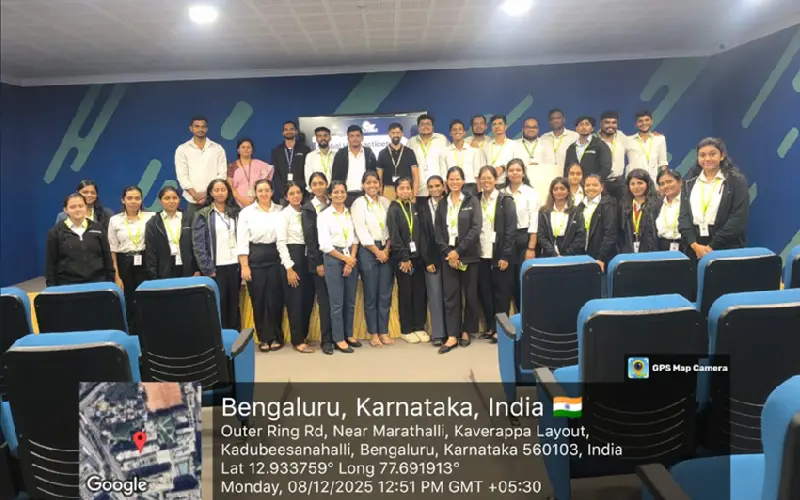
Department of Management Studies
Date: December 8, 2025
Time: 11:00 AM to 1:00 PM
Venue: Manthan Seminar Hall
Resource Person:
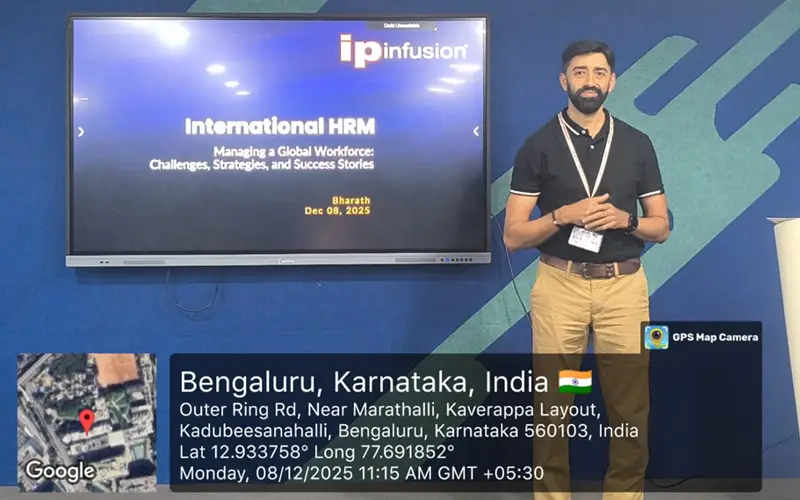
Dr. Bharath Chandrashekar
Head – Human Resources
IP Infusion Software India Pvt. Ltd.
The speaker explained how International Human Resource Management (IHRM) differs sharply from domestic HRM by requiring companies to manage diverse laws, cultures, tax systems, currencies, and employee expectations across countries, making global HR far more complex.
He highlighted why studying IHRM is essential in a globalised world where companies operate 24/7 across time zones, compete for global talent, and face extremely costly expatriate failures. Strategic approaches such as the ethnocentric model (home-country leadership), polycentric model (local leadership), and geocentric model (global best-fit leadership) were discussed.
Recruitment in IHRM goes beyond technical skills, emphasising adaptability, cultural sensitivity, emotional resilience, and tolerance for ambiguity.
The speaker presented real-world failures such as Walmart’s exit from Germany due to cultural misalignment—forced smiling, chants, and American-style service norms backfired—and Euro Disney’s challenges in France caused by rigid dress codes, resistance to banning wine, and incorrect assumptions about local food preferences.
He also stressed on cross-cultural training through pre-departure preparation, in-country mentoring, and especially family support because spouse/family adjustment is the number one factor behind expatriate success or failure.
Performance management varies globally as cultures differ in how they give negative feedback—direct in the U.S. or Netherlands, indirect in Japan or Indonesia—illustrated through Rakuten’s “Englishnisation” initiative. Compensation systems aim to “keep the expat whole” through cost-of-living allowances, hardship premiums, and tax equalisation.
Success stories include IKEA, which maintains consistent global values and ethical standards while adapting products locally, and McDonald’s, which masters “glocalisation” by keeping global brand standards but customising menus for countries such as India and Japan.
The discussion also expanded to IHRM in the digital era, noting that modern global management involves virtual teams facing time-zone conflicts, trust-building challenges, and technological disparities.
It concluded with core lessons: